

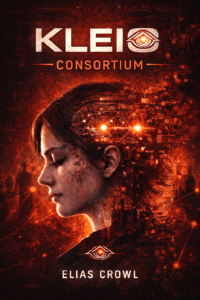
Now Is the Time to Start the KLEIO Trilogy
On June 15, the wait is finally over: KLEIO-Consortium, Book 3 of the KLEIO Trilogy, will arrive in the major bookshops. For me, this is more than just a release date. It is the moment when a story that has stayed with me for a long time takes its final, inevitable step.
Anyone who already knows the series understands that KLEIO was never meant to be just another thriller project. From the very beginning, I have been driven by a question that is larger than technology, larger than control, even larger than the usual engine of suspense: What happens to a person when memory is no longer something private and inward, but something that can be sorted, influenced, and administered? That is where KLEIO begins. And that is exactly where KLEIO-Consortium brings everything to its end.
If you have not entered the trilogy yet, now is the perfect time. Book 1, KLEIO I – External Access, opens the world of Emily Carter, neuro-digital control, shifts in identity, and the quiet, unsettling realization that systems may know more about us than they ever should. Book 2, KLEIO II – Residuum, intensifies that dynamic: the world grows tighter, the pressure sharper, and what at first feels like individual loss of control reveals itself as something structural, larger, colder. That is also how the first two books are presented on the official website: as an urban psychological tech-noir thriller centered on manipulated memory, digital control, and Emily Carter.
And then comes KLEIO-Consortium.
This third novel is not an afterthought. It is not simply a matter of tying up a few loose ends. It is the book the trilogy has been moving toward from the very beginning. Its ending is not decorative. It is necessary. Anyone who has read this far can already feel that the true threat in KLEIO was never technology or surveillance alone. The real danger has always been the quiet shift in what a person can still understand as their own thinking, their own remembering, their own self.
That is why I am not only interested in the question of who is lying. I am drawn to the more disturbing question: What if the lie has already become part of the structure itself? What if control no longer looks like violence, but like care? What if intervention presents itself as optimization? And what if people begin to adapt themselves to the very systems that are slowly rewriting them?
Readers looking for classic thriller elements will find tension, pressure, systems, conflict, and escalation in KLEIO. But readers looking for more than plot mechanics will find something else as well: a story about perception, inner sovereignty, and the political dimension of memory. That is why KLEIO is not presented on the official site as simple action-driven fiction, but explicitly as tech-noir, as a psychological thriller, and as a series about control, memory, and the erosion of identity.
I believe that this is where the trilogy’s real pull comes from. KLEIO does not take place in some distant, untouchable future. The world of these books feels close. Its interfaces, routines, and interventions do not feel like science-fiction ornamentation, but like an extension of something that has already begun. Maybe not in exactly the same form. But certainly in the same direction. And that is why Emily Carter’s path is not an abstract future scenario, but a mirror: for adaptation, for resistance, for the question of how much foreign logic a person can absorb before they no longer recognize themselves.
With KLEIO-Consortium, that movement reaches its endpoint. Or more precisely: the point beyond which there is no escape. The finale forces the trilogy exactly where it always had to go — toward the power structures behind the system, the interests behind the access, and the question of what can still be defended in the end. Not theoretically. Not ideologically. But concretely, humanly, under pressure.
Anyone who has already read Books 1 and 2 will find answers in the third installment — but not comfortable ones. Anyone coming to the trilogy for the first time now has the opportunity to experience it as a complete arc, one whose tension does not emerge only from revelation, but from compression. From the feeling that every new insight makes the ground less stable, not more secure. That is exactly what I wanted KLEIO to do: to create a series that not only drives forward, but lingers afterward.
So here is my clear recommendation: Start now with KLEIO I – External Access and KLEIO II – Residuum before KLEIO-Consortium arrives on June 15. That way, you will not read the finale merely as an ending, but as what it is meant to be: the full release of a story that was built, from the first page on, toward this exact point. The official website already presents Book 1 and Book 2 as available installments of the trilogy, and Book 3 as its concluding volume.
If you love psychological thrillers, tech-noir, dark near-future suspense, and novels about memory, control, and identity, this is your moment. Pick up Book 1 and Book 2, enter the world of KLEIO, and be ready for KLEIO-Consortium on June 15. The end of the trilogy is not waiting. It is coming.