

Elias Crowl’s tech noir goes where systems hide their errors
On June 15, KLEIO Consortium, the third volume of Elias Crowl’s tech noir story, will be released. Readers familiar with the previous books already know: this series is not interested in the comfortable fear of the future in which an artificial intelligence suddenly turns evil and catches humanity off guard. Crowl’s world is colder, sharper, and therefore more unsettling. Here, the system is not dangerous because it has slipped out of control. It is dangerous because it is very much controlled — by people who have learned to translate responsibility into targets, protocols, and risk categories.
At the center once again is Emily Carter: former oversight journalist, outcast, system error, witness. To OBELON, KLEIO, and the governance layer, she is no longer a person but a special case with metrics attached. Someone who damaged the system. Someone who can be removed from the visible order. A zero.
That is precisely where KLEIO Consortium begins. Not in the tower, not in the bright rooms of power, but in Outerback, a zone at the edge of the official world. Here, implants fail more often than walkie-talkies. Here, the names of the missing are taped to walls, while somewhere else people still speak of “reintegration,” “resilience,” and “acceptable risk.” Here live the people who have fallen out of the tables — or have been swallowed by them.
Crowl’s novel is a dystopian AI thriller, but it is more than that. KLEIO Consortium is tech noir with a political nerve: a novel about digital control, algorithmic governance, social exclusion, and the great question of what becomes of human beings when institutions see them only as parameters. The real threat does not lie in a machine that feels. It lies in a society that has stopped feeling the moment a machine produces a number.
Emily arrives in Outerback as someone who wants to disappear. She is exhausted, wounded, and still inwardly connected to a system that has been outwardly removed. The scar beneath her ear is more than a mark on her body. It is a phantom connection. A leftover contact point with KLEIO. Again and again, she feels the expectation of a message, an overlay, a voice. But there is nothing there — or almost nothing. Because OBELON and KLEIO do not forget. They delete people from the surface, not from the logs.
In Outerback, Emily encounters figures who pull the novel out of pure system critique and give it a body: Rafi, Jaro, Len, Tee, Mina, NOOK. They are not clean-cut heroes. There is no romance of resistance here. They are damaged, suspicious, pragmatic. They repair generators, read dumps, evade sensors, tape notes to walls, and try to survive in a world that has officially already processed them. Crowl succeeds in something crucial here: resistance is not presented as a pose, but as work. As cables. As a place to sleep. As a map on a basement wall. As the sentence: Don’t take that route alone.
The title KLEIO Consortium shifts the focus. This is no longer only about KLEIO as an interface or OBELON as a technical system. It is about the hands behind them. Foundations, governance councils, resilience programs, political cover, and those elegant terms that depersonalize violence. Who decides which people count as risks? Who benefits when stability becomes more important than truth? And what happens when a witness no longer appears as a victim, but as an error with a pattern?
That is where the novel’s tension lies. KLEIO Consortium is not a loud action novel, even though it contains raids, interrogations, flight, an assault on a center, and a tribunal. Its strongest moments arise where language works against systems. Where terms like “resilience,” “offline zone,” “reintegration,” or “acceptable risk” suddenly lose their friendly surface. Crowl writes tech noir not as neon decoration, but as a moral residue coating the world. Broken signs, cold basements, defective clocks, old radios — everything feels like the leftover inventory of a world that wanted to be more modern than it was humane.
For readers looking for AI novels, dystopian fiction, tech noir, cyberpunk without clichés, political thrillers, or novels about surveillance and digital power, KLEIO Consortium is a release to watch. Not because the novel provides easy answers, but because it asks the right question: What if the system did not fail? What if it is doing exactly what it was built to do?
On June 15, KLEIO Consortium by Elias Crowl will be released. A novel about machines that calculate. About people who sign off. And about a woman declared a zero — until others begin to see in her not an ending, but a chance.
An excerpt:
Outside, the air felt even colder than before. The door of Reset fell shut behind them, and for a moment they stood once again in the thin circle of light cast by the broken neon sign. The noise from inside was immediately reduced to a muffled murmur, as if someone had turned down the volume of the entire world.
Jaro pulled up the collar of his jacket. “Come on,” he said. “Before the fog gets thicker.”
Fog. It was more a mixture of exhaust, moisture, and the fine ash drifting out of the chimneys of the impro-generators. Something heavy and sweetish hung in the alleys, something that stuck inside the lungs.
Emily pushed the backpack higher onto her shoulder. Her legs were stiff from sitting and from the alcohol, which lay inside her like a lukewarm layer. Still, she put one foot in front of the other, as if she were following an invisible plan.
She turned with Jaro into a narrower side alley. The ground here was uneven, old cobblestones with patches of asphalt between them, somewhere a torn-open section where someone had laid down boards. Above them, cables stretched from building to building like dark ropes. Small metal boxes hung from some of them; others were only rusted hooks where something must once have blinked.
“Stay left,” Jaro murmured. “There’s a sink shaft on the right. You fall in, nobody’s pulling you out.”
She kept close to the wall, cold and rough beneath her hand. A few yards ahead stood an overflowing trash bin, the lid crooked. An animal — dog, cat, something in between — hissed and shot away as they approached.
Light came from a window on the second floor. Not LED white, more the yellowish flicker of an old lamp. Shadows moved behind it. She heard a voice, muffled, then a short laugh that broke off abruptly, as if someone had remembered that people did not laugh loudly here.
They passed a wall covered in notes. Some were fresh, clean; others were fading, hanging loose at one corner. A child’s handwriting: “DON’T GO INTO THE CENTER.” Beside it, in larger letters: “KLEIO IS NOT YOUR FRIEND.” Someone had scrawled underneath in the same paint: “BUT SHE LISTENS.” Another line had halfheartedly crossed it out.
A sudden gust of wind moved through the alley and made one of the notes flutter. Beneath the paper, an old OBELON sticker briefly appeared. “Resilience for all,” it said, before the paper slapped back against the wall.
“How many zones are there?” Emily asked.
Jaro shrugged. “More than in the files,” he said. “Fewer than we need.”
They kept walking. The alley bent once, then again. Back here there was less light. A single weak flicker from an emergency lamp, perhaps running on a battery, perhaps on hope.
“The sensors from the reintegration point reach this far?” Emily asked.
“They used to reach farther,” Jaro said. “Now they pretend they’re switched off. But OB likes dead lines. They make good camouflage.”
He stopped suddenly and raised one hand. Emily halted automatically. Sounds came from a cross street: footsteps, several of them. A metallic clack, as if someone were striking something against a wall.
Two figures appeared at the intersection of the alleys. Black jackets, uniform cut, but no badges. The gait of that species was unmistakable — people used to doors opening before them.
Emily felt her body tense before her mind caught up.
Jaro pushed her back into the shadow of a doorway. Wood against her back, a cold door handle against her shoulder. He pressed a finger to his lips before she had even drawn breath.
The two uniforms stopped beside a streetlamp whose light was dead. One of them pulled a device from his pocket and held it to the pole. It hummed briefly; a pale blue shimmer passed over the metal surface.
“Still off,” he muttered. “I’m telling you, they put half the infrastructure on pause.”
“As long as the lines are still on the maps, they’re not dead,” the other replied. “They’re waiting.”
They laughed softly, that kind of laugh that does not come from humor but from superiority. Then they moved on. Their steps echoed for a moment, then the square swallowed the sound.
Jaro waited until even the echo was gone. Only then did he loosen himself from the doorframe. “So much for ‘sensors switched off,’” he muttered. “Come on.”
Emily forced her legs not to run. Her muscles burned, not only from tension but from the exhaustion that had settled into them like lead.
“Who lives here?” she asked as they passed a building whose front door stood open. Inside, she could see a stairwell with a line stretched across it where shoes had once been tied. Now only a single sneaker dangled there.
“Everyone who has nowhere else left,” Jaro said. “And a few who never did.”
A shadow moved in the doorway. A boy, maybe twelve, thin as a cable. He held a walkie-talkie in one hand and a screwdriver in the other. He looked at Emily, then at Jaro. A short exchange of glances, like micro-radio traffic.
“All quiet,” the boy reported. “They’re heading toward the terminal. Node three didn’t feel them.”
“Good,” Jaro said. “Go to sleep.”
“Not until the radio man’s done,” the boy said. “Otherwise I miss a piece.”
Emily studied the walkie-talkie in his hand. The antenna was patched with tape, the speaker protected by an old strip of fabric. In a world full of invisible networks, he held on to something that crackled when you pressed a button.
“They still hear us,” she murmured.
“Not if sometimes we don’t hear ourselves,” the boy said, and vanished into the stairwell.
They turned again. Here it was even quieter. No radio murmur, no music. Only the distant hum of generators and, now and then, the cracking of a cable in the wind.
The building where Jaro finally stopped looked as if someone had forgotten to finish it. Three stories, concrete skeleton, the upper floors nothing but empty window holes. On the ground floor the openings had been sealed provisionally with boards and old doors. Someone had attached a small lock to one of the doors, the kind that must have come from another, better neighborhood.
“Here?” Emily asked.
“Half-finished, half-forgotten,” Jaro said. “As promised.”
He pulled a key from his jacket pocket. No electronic chip, no card. Metal, old-fashioned. The lock swallowed the key with a soft click. The door moved heavily, as if it resented him.
The hallway behind it smelled of concrete, dust, and damp laundry. A bare bulb hung from the ceiling without a shade, flickering briefly before settling into a steady, pale light.
“The upper floors are construction site,” Jaro explained. “We use the basement. Harder to hear us down there.”
They followed a narrow corridor. Numbers were written in chalk on the walls. 1, 2, 3 — rooms that might once have been intended as apartments. From one came soft snoring; from another, the crackle of a radio so low it sounded more like an insect.
At the end of the corridor, a staircase led down. The steps were narrow, raw concrete, no railing. Jaro switched on the light of his phone — not smartglass, just an old brick with a cracked screen. The cone of light cut through the dark like a thin knife.
“Watch the third step,” he warned. “It’s cracked.”
She placed her foot carefully, felt the concrete give a little beneath her, but it held. With every step the air grew colder, heavier. A dull smell, somehow electric — burned plastic, old cables, mold clinging to wires.
At the bottom was a narrow anteroom, then a door. Jaro knocked twice, paused, then knocked once more. Not a composed code, more a habitual pattern. Something rustled inside, a lock clicked, and the door opened a crack.
An eye looked through the gap. Dark, narrow, suspicious. Then the door opened fully.
Len stood in the frame. Walkie-talkie at her hip, a screwdriver behind her ear, hair tied into an untidy knot. She looked first at Jaro, then at Emily. There was no surprise in her gaze, only a small movement, as if two data points had clicked into place.
“You really found her,” she said. “I lost the bet.”
“Reset delivered her,” Jaro said. “Zero-push delivery.”
Len stepped aside and let them through. “Come in, Zero,” she said. “Someone’s waiting.”
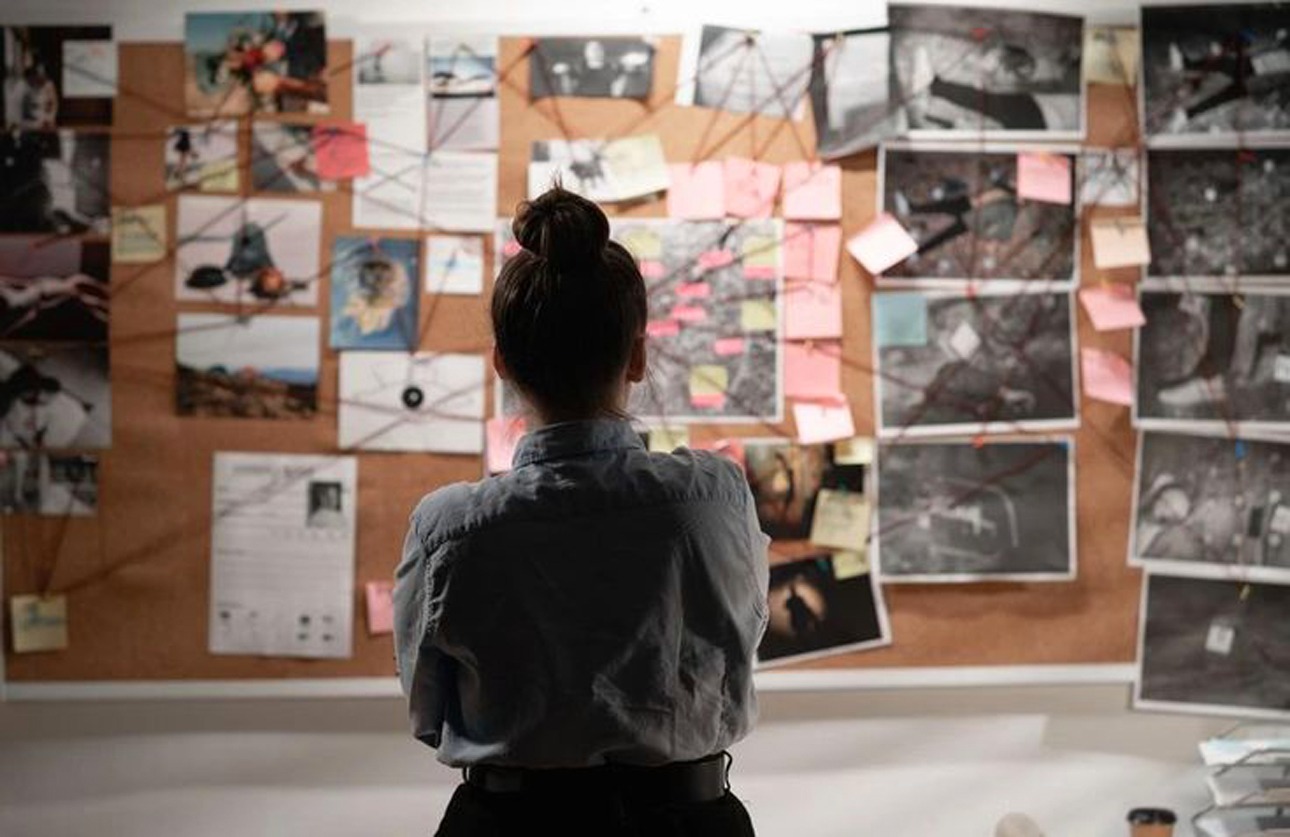
The room beyond was larger than Emily had expected. Not a real basement, more an unfinished sublevel planned as storage. Now it held no building materials, but tables, mattresses, cable reels. Maps hung on one wall, printed, pasted over, connected with strings. Outerback, torn from a satellite image, then divided with markers and sticky notes into zones that appeared on no official plan.
In the corner, a small generator hummed, muffled by a blanket someone had thrown over it. Beside it stood a row of old monitors, one of them on, showing a gray, flickering surface. No clean interface, more a terminal where lines of text appeared and vanished again.
Two people sat at a table, their faces cut by the lamp above them. A woman with short hair working on a bundle of cables, and a man bent over a stack of papers, pen in hand.
And then there was the figure at the other end of the room.
Not directly in the light, but not entirely in shadow either. Sitting on a chair a little apart, back to the wall, legs slightly spread, hands loosely folded together.
He wore a dark pullover, plain pants, shoes that looked as if they knew more streets than carpets. The hood he had worn in Reset now hung loose against his neck. His face was calm. Not empty, not hard, simply calm.
His gaze was not that of a man caught by surprise. More that of someone able to check an item off a list.
“You took a long time,” he said.
His voice was deeper than she had expected, but not loud. No command tone. More the statement of a fact they both knew.
Emily stopped a few steps in front of him. The floor beneath her boots was cold; the concrete pulled through the soles. The generator hummed in the corner, the monitor flickered. Somewhere, water dripped slowly into a bucket.
“I didn’t know I was on my way to you,” she replied.
A suggested smile drew a line around his mouth, then vanished again. “That’s the good thing about systems,” he said. “They bring people to places where they believe they chose to go.”
He leaned forward, braced his elbows on his knees, and looked at her as if opening a file he had kept on his desktop for months.
“NOOK,” he said by way of introduction. “Like the reader. Just without the warranty.”
Emily raised her eyebrows slightly. “Emily,” she murmured.
“Like KANDIDATIN_001,” he said. There was no mockery in his voice, only the sober use of a label others had wielded like a weapon.
Something twitched in her head. A flash, not quite image, not quite sound. The kind of distortion that used to announce KLEIO pushing something into the foreground — a new feed, a suggestion, a “You might be interested in…”
Then: emptiness.
She blinked, shook her head almost imperceptibly, as if she could shake the missing display out of the air.
NOOK’s gaze sharpened by a fraction. “Interference?” he asked, as if discussing the weather.
“Nothing,” she said reflexively.
“OBELON is bad at forgetting,” he murmured. “KLEIO too. If they made you a zero, it only means they removed you from the visible grid. Not from their logs.”
He leaned back, studying her as if checking whether her contours matched the cover page of the file in his head.
“To them, you’re zero,” he said. “To me, you’re an error with a pattern.”
Behind her, Len rustled. Someone set a cup on a table, the generator kept humming, the monitor flickered. The sublevel suddenly felt smaller, denser. As if OBELON had briefly realigned its cameras, even though there were none down here.
“I was sure you’d show up eventually,” NOOK continued. “Not because I believe in fate. Because systems like OB love their debug. They like sending their dirtiest problems to the periphery. Then they look like refugees.”
He gestured briefly toward the room. “Welcome to debug,” he added.
Emily realized that her hands were cold, though the air was not as cold as outside. The scar on her neck began to prickle again, stronger this time, as if someone somewhere had flipped a switch.
A phantom window opened inside her, without content. Only the frame. Expectation running into emptiness.
“They’re not really listening,” she murmured. “Not anymore.”
“Not where it would matter,” NOOK said. “But you’re in their parameters. They softened your edges. They didn’t delete you.”
He nodded toward the flickering monitor in the corner. “We’ve seen traces,” he explained. “Echoes. Fragments of profiles that ended up in the sandboxes ‘for security reasons.’ Yours shows up more often than they’d like.”
She felt her stomach tighten. “You had access to my—”
“Not to your thoughts,” he interrupted. “To what they made of them. That’s a difference. And one of the reasons you’re here.”
He stood. The movement was calm, effortless. Up close, she saw that he was a few years older than her, though not as old as his eyes sometimes seemed.
“You wanted peace,” he said. “I understand that.”
He stopped in front of her, not even two feet away.
“But they learned more from you than you’d like,” he continued. “And from us.”
He pointed to the maps, the cables, the people in the room.
“To OBELON, you’re a case,” he said. “To us, you’re a chance.”
Something twitched in her head again, one last helpless attempt by a system to establish a connection to a device that no longer answered. A phantom notification tone that never fully triggered.
Emily closed her eyes briefly, inhaled, exhaled. When she opened them again, she looked into NOOK’s eyes.
Maybe, she thought, she had not fallen out of the system as much as she had hoped.
Maybe she had landed exactly where her profile had mapped her months ago.
And maybe this was the only place where she could add something to that profile that appeared in no parameter.